Blog

Inspiring Bedlam

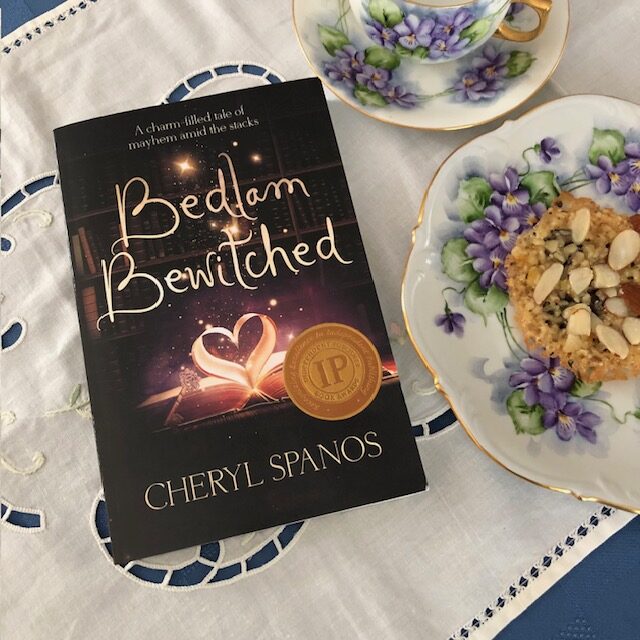
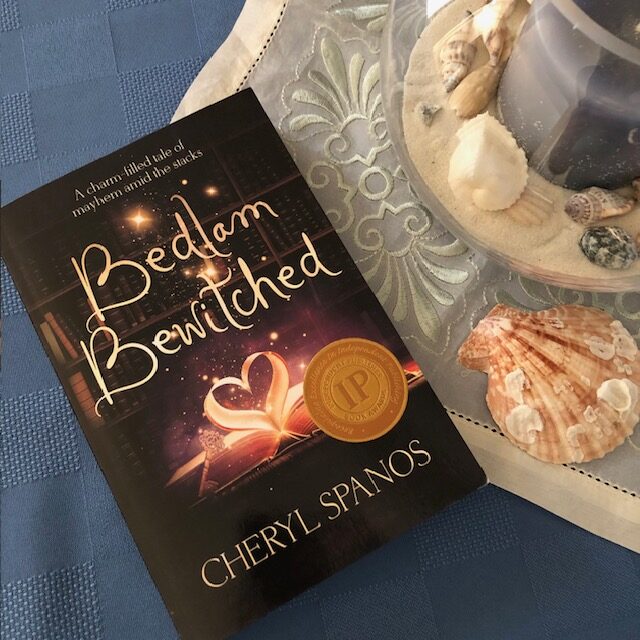
Bedlam Bewitched book with tea and cookie for Inspiring Bedlam post

In a past author Q & A, I was asked what inspired me to write Bedlam Bewitched. Good question. Normally, I consider myself more of a plot-driven writer. I start with a general idea for a story and begin writing from there. But in Bedlam, the character came first—Cory Smyth, my plucky, witchy FMC.

Cory (or rather an older version of her) first appeared as the narrator in one of my short stories. She views life through a “romance novel” lens. Her favorite books inform and color her every perception of the world around her. These romance-hued observations made her a delightful unreliable narrator. She was so fun to write and inhabit that I decided she needed a novel of her own.

Once I knew my main character, Cory’s love of books suggested the magical bookstore which became the setting for the story. Of course, she needed a worthy opponent in the grumpy, buttoned-up, literary-fiction-loving Jack. Throw in Cory’s mother and aunts—three meddlesome, whiskery, weird sisters, who run Cory’s life—and the story took off.

What about you? What generally comes to you first? Plot or character?

Plotting

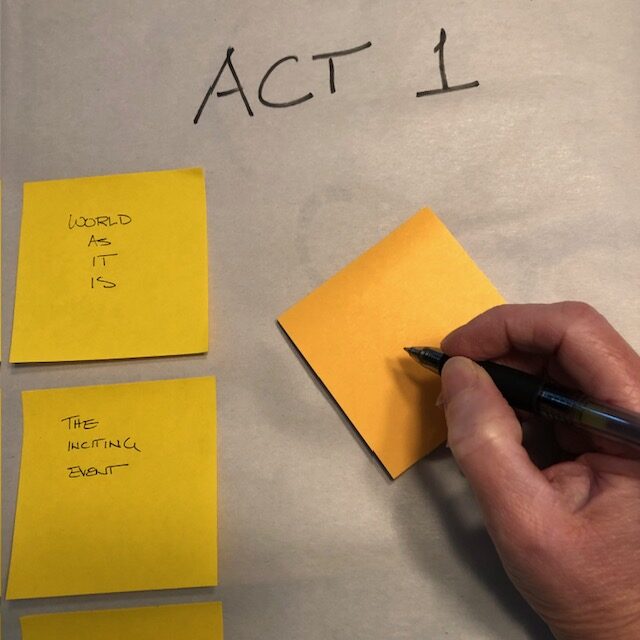
Photo for blog post on Plotting

This past December, I attended an excellent presentation on Painless Plot Pointers given by David Macinnis Gill. David is the author of young adult and middle grade novels and has taught plot structure for the MFA program at Vermont College.

In his workshop, David walked us through the new Three Act plot structure. The traditional plot structure divides a novel into three roughly equal acts: beginning, middle, and end. But with this updated method, the Second Act is expanded, taking up about 50% of the book. The new Act 2 consists of three parts with a “Turn” in the middle and two mirror journeys on either side. The Turn occurs roughly at the midpoint of the book. This incident damages the hero so they cannot go back and challenges their beliefs, redefining their journey ahead.

David walked us through the key scenes of each of these Acts and introduced his “Sticky Note Plotting” method for identifying and ordering these scenes. When he’s working on a novel, he uses actual sticky notes to record his scene ideas and position them in the plot grid. Then he employs the resulting outline to guide him as he drafts his novels. We had an opportunity to apply his technique in a group exercise as part of the workshop.

As for me, I’m more of a pantser than a plotter when drafting a novel. But as I’ve just completed the first draft of my latest novel-in-progress, I’m now in revisions. This gave me the perfect opportunity to analyze my manuscript and identify these plot beats in my own story. It’s helping me find places where I can strengthen my story and character arcs.

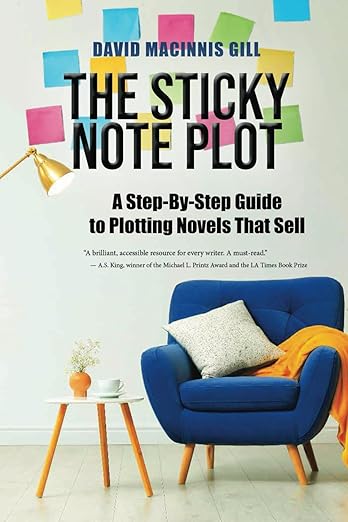
Cover of The Sticky Note Plot by David Macinnis Gill for post on plotting

If you wish to learn more about David’s plotting method, check out his book. The Sticky Note Plot: A Step-By-Step Guide to Plotting Novels That Sell is available on Amazon in several formats. You can find it here.

Sweetheart Sale

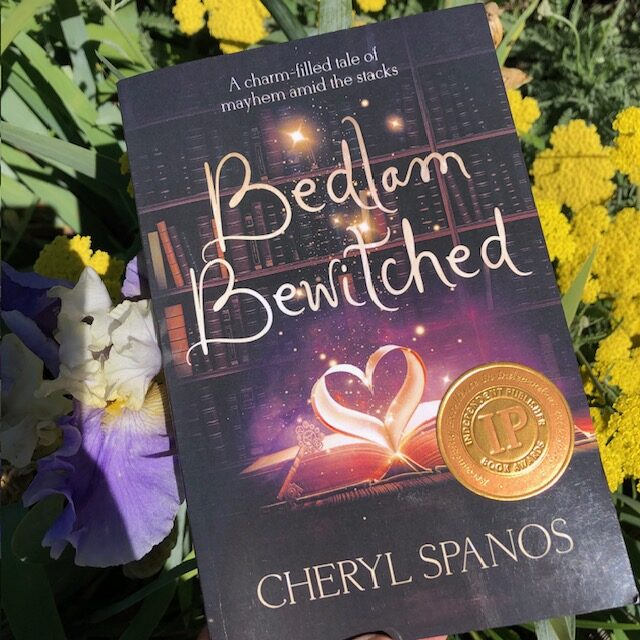
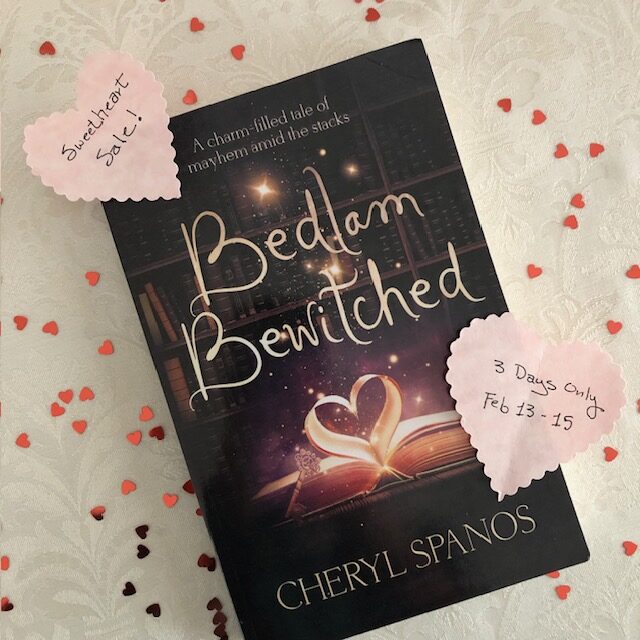
Bedlam Bewitched book cover image for Bedlam Sweetheart Sale post

For Valentine’s Day, I’m running a limited-time sweetheart sale of Bedlam Bewitched. For three days only from Friday, February 13th through Sunday, February 15th, 2026, you can purchase my book at a special discount price.

Looking for an escapist teen fantasy with a side of cozy mystery and romance? In Bedlam Bewitched, a teenage witch must save her uncle’s chaotically-enchanted bookstore from scheming adversaries and swindlers from her past. Can Cory work her magic to save the bewitched shop? Or will her efforts cost her the business and perhaps even her life?

Purchase the eBook for $2.99 (List price $4.99) in this Amazon KDP Countdown Deal.

Visit the link above to take advantage of this offer. Don’t wait too long. Much like the enchanted mystery novels in Bedlam Books, these bargain prices will soon disappear.

A New Year, New Goals

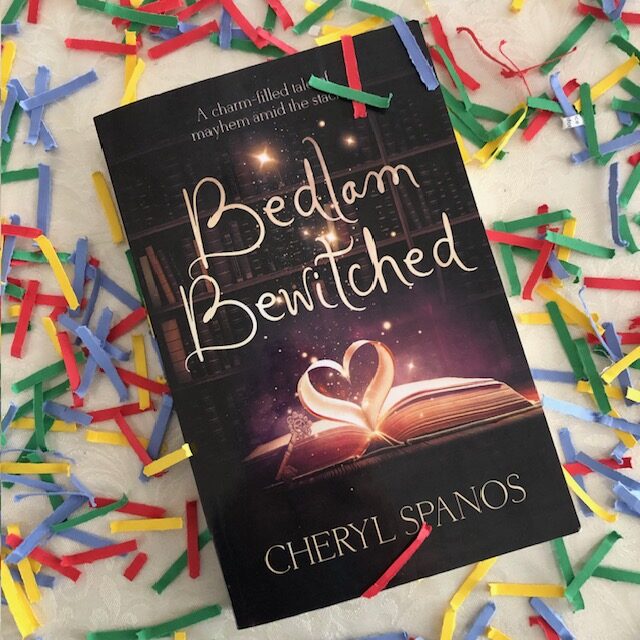
Photo of Bedlam Bewitched book cover surrounded by confetti for Post on A New Year, New Goals

The turn of a New Year offers time to reflect back and look forward. I’m not much for resolutions, but I do set writing goals for the coming year. Looking back, my writing goal for 2025 was to complete a first draft of my novel-in-progress. I didn’t quite get there, but I did make significant strides toward that objective. In 2025, I penned 21 chapters. I just finished Chapter 29, which brings me to about 70,000 words. Only two more chapters to go! Thus, my goal for this month is to complete that first draft and begin revisions.

To help with those revisions, I recently attended a couple of informative craft webinars presented by the SCBWI (Society of Children’s Book Writers and Illustrators). In one session, Jessica Vitalis gave an excellent presentation on using symbolism to transform your writing. We’re all familiar with the use of metaphor and simile to create vivid imagery. But she explained and illustrated several more: mood, motif, allegory…

Another was “objective correlatives.” I’d never heard this term, but I have actually used this technique without knowing what it was called. Objective correlatives are objects that represent an emotion in the story. In Bedlam Bewitched, Cory carries her favorite romance novel in her apron pocket. For her, it represents a source of reassurance and hope. We see that in an early scene, when she finds a box of romances in the basement and formulates her first plans to save Bedlam Books. The romance novel also informs a pivotal plot twist, but I won’t spoil that here.

One of Jessica’s final bits of advice was not to worry about symbolism in your first draft. Get the story down first. Once you have that draft, you can look for the symbols that are organically present. She suggests creating a “mind map” to brainstorm possible meanings around those objects. Then you can incorporate this symbolism to add depth to your story in subsequent edits.

Now, I’m off to pen my final chapters. But armed with these new tools, I’ll soon be ready for revisions.

How have you incorporated symbolism in your work? Can you think of examples from a favorite novel or story?

The Great Dickens Christmas Fair

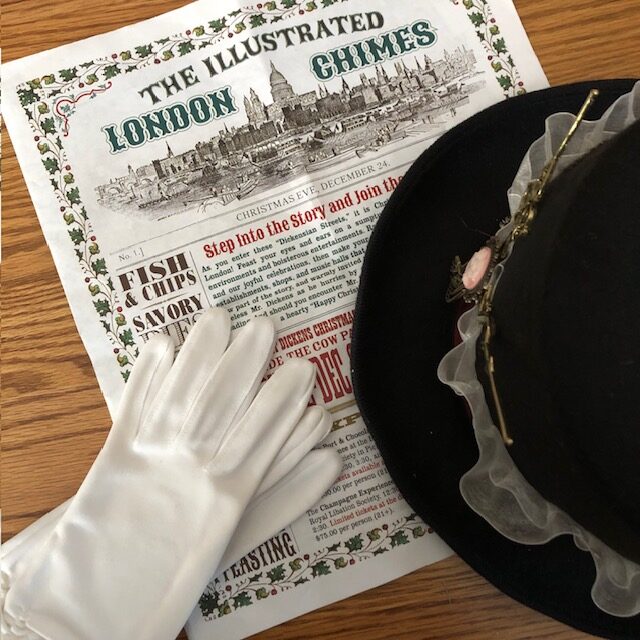
Photo of program, top hat, and gloves for post on the Great Dickens Christmas Fair

For the past several years, the Great Dickens Christmas Fair has been on my holiday radar. I first spotted it while researching Bay Area outings for when my guests visit over the Christmas holidays. Unfortunately, the timing never worked out. The fair closes the weekend before Christmas, and my guests arrive a few days later.

This year, I decided that we should not wait for visitors. So about a week ago, I attended my first Dickens Fair.

The Great Dickens Christmas Fair is a step back in time to a fictional Victorian London. For a few weekends in December, the Cow Palace is transformed into a maze of streets and alleyways with Dickensian names, lined with eateries, pubs, stages, and artisan shops. Mostly, we wove through the “streets”, checking out the wares in the shops and stopping for lunch. Of course, I had to try roasted chestnuts. Entertainment ran continuously on a several stages, where you might hear carolers, fiddlers, or a bit of theater. You could even dance at Fezziwig’s if you were so inclined. Wandering these streets, you’ll meet actors dressed as various characters from the Dickens novels, plus an assortment of other gentlemen, ladies, chimney sweeps, sailors, and a few scoundrels.

But it wasn’t just the professional players who had dressed for the occasion. What surprised me most were the number of attendees who came dressed to the nines in full Victorian garb. There were ladies and even young girls in hoop-skirted gowns with bonnets carrying reticules. Gents sported vests and cravats under coats and top hats. Some improvised with Steampunk-inspired apparel. And if you wanted to upgrade your attire, the vendors inside sold period clothing and accessories.

Dressing up looked like such fun. We decided that next time we should come in costume, too. The gents would have an easier time than the ladies putting together something that could pass for authentic. But for the women, corsets, floor-length gowns, lace collars, and bonnets aren’t exactly something you could pull from your closet. Clearly, some of these folks made a serious investment in their look. I’d wager this fair is a yearly tradition for them.

Have you ever attended a Victorian or Renaissance Fair in costume? Or chose to cosplay for a convention? Who did you go as? How did you create your costume?

Happy Christmas!

SCBWI Oktoberfest 2025

SCBWI Oktoberfest 2025 schedule and badge image for blog post

A couple of weeks ago, I attended Oktoberfest 2025—a local writing conference presented by the San Franciso North & East Bay chapter of the SCBWI (Society of Children’s Book Writers and Illustrators). Every other year, on the third Saturday of October, my regional SCBWI branch organizes this one-day in-person event. The conference features an inspirational keynote speaker, followed by a choice of breakout craft sessions and connection opportunities. The conference also offers a menu of optional extras, such as a manuscript critique, a meeting with an agent or editor, or a headshot photo shoot.

This year, my goal was to refresh my craft and find some inspiration, so I focused on the breakout sessions. I’m currently working on drafting the final chapters of my next novel, and hope to be revising early in the new year. Thus, I was particularly interested in Jennifer March Soloway’s session on “Beginnings and Endings” and the industry panel session on “First Ten Pages.” Those first pages have a heavy lift. They need to hook the reader, present the promise of the story, set the tone, and establish voice all in a few short pages.

Likewise, the ending needs to complete the arc of the story. Has the protagonist changed or grown? Have we delivered on the promise made in the beginning? And did we do it with a surprising twist? Oh boy! It’s little wonder that we writers spent so much time writing…and rewriting…those opening and closing pages.

I also really enjoyed Nadia Salomon’s session on “Using Mentor Texts to Tell a Better Story”. She discussed how other books and resources, aka “mentor texts”, informed and shaped her own writing. These stories helped her to identify theme, story structure, emotion, and even marketing for her own work. Although she is a picture book author and I’m a YA novelist, her talk had something for me too. I came away with a couple tips for finding my own mentor texts.

Reflecting on what I learned, I’m inspired to get back to my draft with renewed energy. And I have a couple more tools in my back pocket to help me navigate this writing journey.

Finally, do you have a favorite first line of a book? What was it about that opening that pulled you into the story? Did the ending deliver in a way that satisfied and surprised you?

England Travels

I’ve just returned from a 10-day trip to England. I’m still fighting the jetlag, but the trip was fabulous. We spent seven days in London, then took day trips to Cambridge, Bath, and the Cotswolds.

I hadn’t visited England in decades, not since I was a college student on a term abroad. Long ago, I’d spent a semester in beautiful Bath, including many field trips to other locations—Oxford, Stonehenge, Stratford-upon-Avon, and more. As one of my courses was on British playwrights, we read and saw about a dozen plays. That entailed trips to London to the Barbican Centre, the National Theatre, and of course, the West End.

On this trip, our London tour included a delightful variety of sightseeing and experiences, many of which I hadn’t seen during my previous visit. We toured landmark sights such as Westminster Abbey, St. Paul’s Cathedral, and the Tower of London. But the trip also included some fun culinary adventures such as a food tour of the East End and an afternoon tea. Of course, we had to see a show this time too, so we booked tickets to Six: The Musical, which I enjoyed immensely.

St. Edward's Church door in Stow-on-the-Wold. Illustration for England Travels post.

One of my favorite trip memories occurred in the Cotswold village of Stow-on-the-Wold, where I snapped this photo of the door to St. Edwards Church. Two entwined, ancient yew trees frame this old wooden portal. This picturesque door is rumored to have provided the inspiration for Tolkien’s Doors of Durin, the entrance to Moria. So cool!

It’s interesting how past experiences can pop up in our work. My former time in England informed parts of my own novel, Bedlam Bewitched. A memorable afternoon tea at a famous department store provided the inspiration for the “high tea” scene in my novel. Perhaps memories from this current adventure will appear in a sequel?

How have your own travels inspired your writing?

Afternoon Tea tray of sweets, scones, and sandwiches. Illustration for England Travels post

“I took a bite, savoring the balance of sugar and fat. I didn’t know which was sweeter, the cake or my ingenious little plan.”

– from Bedlam Bewitched

Comp Books

Image for Comp Books post showing an example with three book or film covers

A few years back, when attending a writer’s conference, I signed up for a group pitch session with a literary agent. I had a complete and polished manuscript and had honed a pitch. From prior experience (albeit years earlier), I assumed the pitch would consist of genre, word count, and the back cover teaser. When it was my turn, I recited my well-rehearsed lines. The agent smiled in all the right places and was complimentary, then she asked me about comps. I didn’t have an answer. She responded that I needed to “do some research.”

I recently attended a very good SCBWI presentation on this topic. Agents and editors alike now expect authors to be able to come up with comparable titles for their books. The agents use these to pitch their client’s projects to editors, and editors use them to present to their acquisitions and marketing departments. This information helps them get a quick feel for your project, determine its place in the market, and gauge how well they think it will sell.

These comps have a typical formula: “My book is X meets Y.” In place of the variables, you fill in two titles that are comparable to your book in some aspect. But there are many more guidelines around this formula. Ideally, the two titles should have been published recently (i.e., within the past 5 years). They should be successful books, but not runaway bestsellers. For instance, don’t compare your fantasy to Harry Potter or your YA dystopian to The Hunger Games. They also should reflect the genre, tone, and target reader of your book. Sounds simple, but it’s not.

This formula has been around for years. In the past, it was most commonly used to pitch high-concept novels. For example, NYT bestseller What the River Knows by Isabel Ibañez is described as “The Mummy meets Death on the Nile.” The Mummy evokes the magic, the archeology, and the Cairo setting of the book, while Death on the Nile also suggests the mystery behind the death of the young protagonist’s parents. Note that one of these titles is a film and the other an Agatha Christie classic. Neither one reflects her book’s YA genre or meets the recent publication criterion (unless she intended the 2017 version of the movie). These exceptions demonstrate that these are not hard rules, but rather guidelines.

I really struggled with this for Bedlam Bewitched. It’s a YA contemporary fantasy, but not dark academia or traditional paranormal romance (There are no vampires or werewolves). It’s also part cozy mystery with plot threads involving the disappearance of Cory’s father and the reappearance of Jack’s formerly deceased fiancée. But it’s not a murder mystery with an amateur sleuth. I would categorize it as a “cozy fantasy with witches.” Although I searched the YA shelves back then, I still had trouble finding comps. Fortunately, the popularity of “cozy fantasy” and “witchy” novels have surged in the past year, making it easier to find companion titles. This new information will better prepare me for my next novel.

As a reader, what do you think of this formula? Would an “X meets Y” pitch entice you to pick up a book? Could you describe your latest writing project or favorite novel using this technique?

Celebration Sale

Image for Celebration Sale post showing Bedlam Bewitched book cover, IPPY Award, and sale tag

To celebrate my IPPY award win, I’m running a first-ever, limited-time sale of Bedlam Bewitched. For three days only from Friday, August 15th through Sunday, August 17th, 2025, you can purchase my book at special discount prices.

Purchase the eBook for $2.99 (List price $4.99) in this Amazon KDP Countdown Deal.

I’m offering the paperback for $13.99 (List price $15.99) from IngramSpark through this exclusive Share and Sell link.

Visit the links above to take advantage of these offers. Don’t wait too long. Much like the enchanted mystery novels in Bedlam Books, these bargain prices will soon disappear.