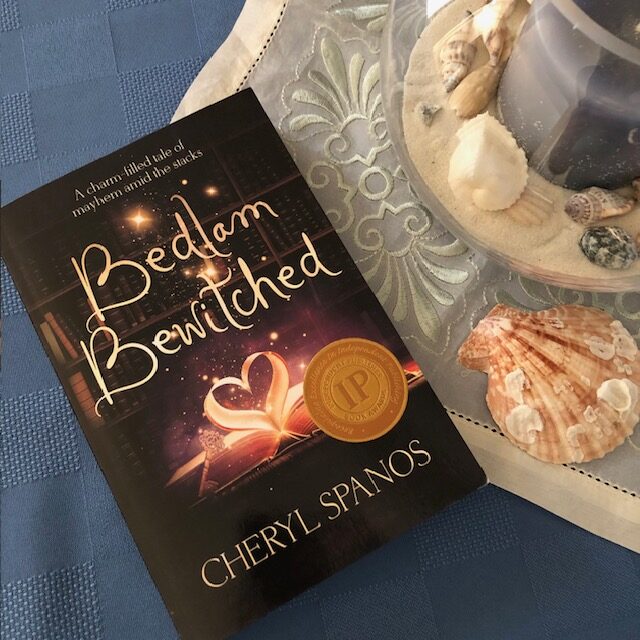
Every year, my writing critique group gathers in August for our annual writer’s retreat. My plan for the weekend was to work on a sequel to Bedlam Bewitched. While looking through my notes, I found a document that I’d written years ago outlining the “rules of magic” for my Bedlam universe. I thought this was interesting, so here is an excerpt:
Who can have magic and who can’t? The ability to do magic is an inherited trait. To be a Magus, you generally have one or more parents with this ability. Although rarely it can surface in a child with non-magical parents, provided there is some Magus ancestor. The gene for magic has been passed down, but remains recessive, appearing to skip generations.
Magic cannot be learned. Thus, a Plebeian with no Magus ancestry cannot perform magic just by reciting the spells. But like any talent, if not practiced, magical ability will not improve and skill will not develop. You can’t perform spells that you haven’t learned, any more than you can play the piano if you’ve never taken a lesson. Thus, a Magus who is not aware of his/her talent could appear to be a Plebeian. Magi perform magic with varying degrees of skill.
Magic is not performed by wands or charmed trinkets, but by spells. The Magus breathes life into the spell (whether spoken aloud or merely thought into existence). The spell becomes a living entity and goes about its commanded purpose. But once a spell is cast, it can develop a will of its own and have unintended consequences. Spells in the hands of the inexperienced can very easily spin out of control. The more powerful the Magi the better the control, although complete control is impossible.
Objects that have been infused with magic, such as the books and figures in Bedlam Books, are somewhat sentient. They hide their magic from Plebeians. They run away or fight back when threatened. That makes a magical bookstore like Bedlam Books a very unpredictable and somewhat maddening place (and Bedlam the ideal name). With so much magic confined in a small place, the potential for things to spiral out of control is immense.
What are the limitations of magic? (1) Spells cannot create something from nothing. For instance, you cannot use a spell to conjure up food or money or clothing. (2) Transfiguration spells are generally temporary and wear off. (3) Magic, like everything else in this world, ages and breaks down. Spells will weaken over time. No spell is permanent. (4) Spells cannot resurrect the dead (At least not permanently and they definitely go very wrong).
Cory occasionally does defensive magic. What is that? And how does it differ from regular spells? Standard spellwork is conscious and intentional. It is an incantation that you speak or think. Defensive magic is involuntary. Moments of panic trigger this organic magic—a defense mechanism (like a fight-or-flight response) to protect a person from danger. The problem is that it’s unpredictable and hard to control.
Can every Magi do defensive magic or just Cory? Other Magi can do defensive magic as well. A small child’s first manifestation of magic is likely to be of this kind. As a person grows, they generally gain more self-control and self-mastery. But Cory is such an impetuous soul that she has never been able to master this. And as she has grown, the reaction itself has become stronger.
I hope you’ve enjoyed this peek into my magical world. If you liked this post, please check out Bedlam Bewitched.